


The Rule of Nine: Building an Activewear Wardrobe That Actually Gets Worn
Open the drawer. Count what is in it, then count what you have worn in the last month. For most women the first number is somewhere past twenty and the second is closer to six. The problem is almost never that you own too little. It is that you own the wrong ten, and the six you love are always in the wash.
01 — The Real Problem
You Do Not Have a Quantity Problem
There is a particular drawer that exists in a lot of homes. It holds a legging that went sheer somewhere around the eighth squat and has been demoted to house wear. A sports bra bought in a size that made sense at the time. Three T-shirts from three different running events. A pair of shorts with a waistband that has stopped gripping. Two pieces that are genuinely good, which is why they are never available when you need them.
Nothing in that drawer is unusable. That is precisely the trouble. Each piece is just functional enough to keep, and not good enough to reach for. So the drawer fills, the rotation shrinks, and the gap between the two numbers grows until getting dressed to train becomes a small daily negotiation you did not sign up for.
India has roughly 110 million people now training in some organised way, and women are the fastest-growing part of that number. Which means an enormous amount of activewear is being bought right now, mostly one impulse at a time, mostly without a plan. The result is predictable: fuller drawers, smaller rotations.
A wardrobe is not what you own. It is what is clean, comfortable and within reach at six in the morning.
02 — The Arithmetic
Why the Number Is Nine
Nine is not a style rule. It is a laundry calculation.
Assume four to five sessions a week, which is what most consistent women in Indian metros actually train. Assume a wash roughly twice a week, because activewear should not sit in a bag until Sunday. Assume that at least one of those sessions is outdoors, one involves lying on a mat or a reformer, and one runs straight into the rest of your day without a change of clothes.
Run those numbers and you need three bottoms, three tops that need nothing underneath, and three layers. Nine. Below that you are washing on demand, which is how good fabric dies early. Above that you are buying variety rather than capability, and variety is what fills the drawer without changing the rotation.
The Test
Before any piece enters the nine, it has to answer one question: what does this do that nothing else I own already does? If the honest answer is “it is a different colour,” it is not a tenth piece. It is a replacement for one of the nine, or it is nothing.
03 — The First Three
Three Bottoms, Doing Three Different Jobs
Bottoms take the most abuse and get the most wear, so this is where the money goes and where compromise costs the most. Three, not five, and each one earning its place by doing something the others cannot.
The workhorse legging
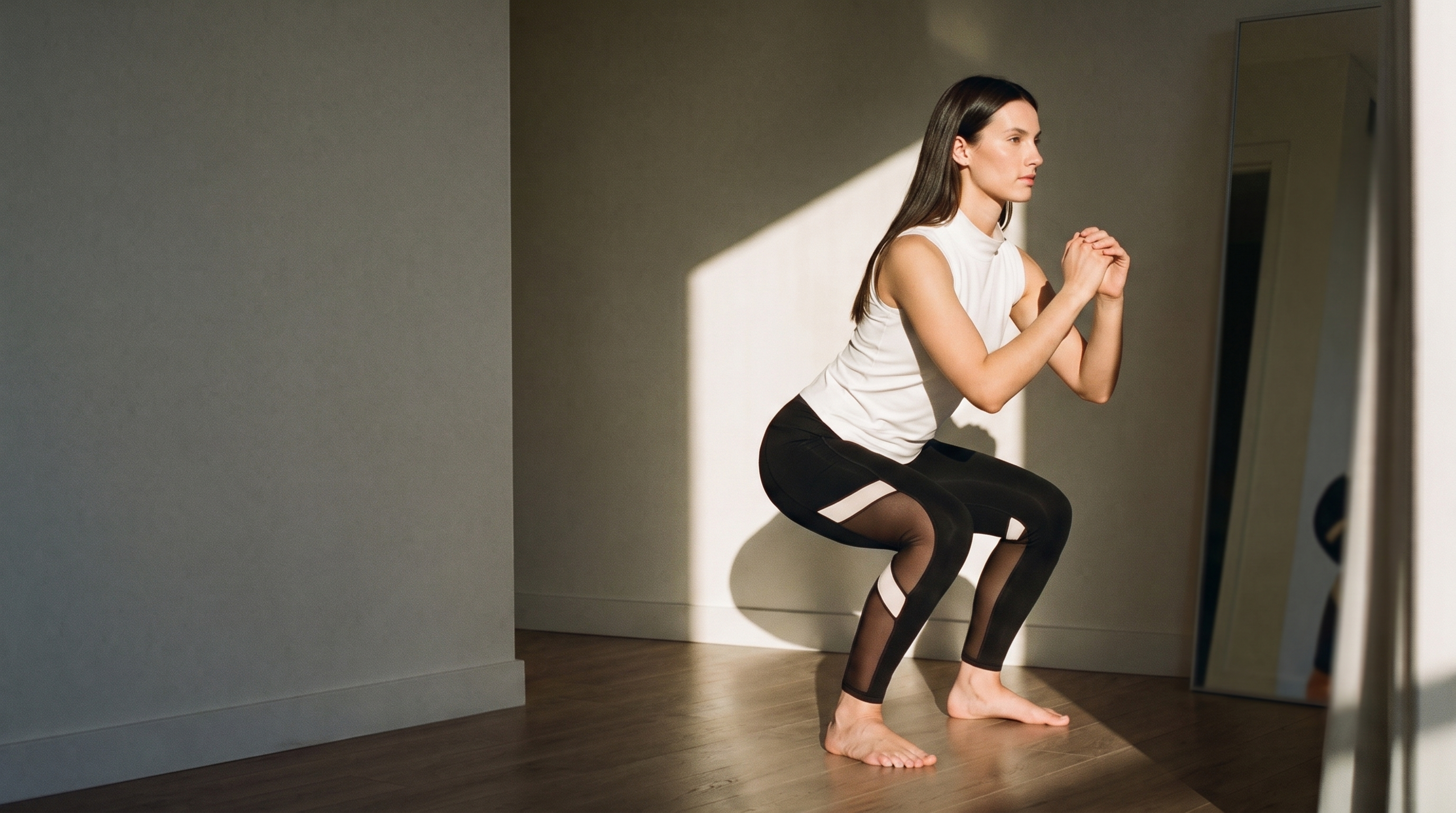
Black, high-waist, opaque under full stretch, and comfortable enough that you forget it exists. This is the piece you will wear more than anything else you own, which is exactly why it should be the best thing you own. The Original Core Mesh-Slit legging in black is built for this role, with breathable slit panels placed where heat collects rather than where they will be photographed.
The legging with pockets
This sounds like a small distinction until the first time you walk to the studio, run outdoors or spend a travel day in them. A deep side pocket that holds a phone without swinging changes what a legging is for. The Enhance Mesh Pocket legging exists for the sessions that begin or end outside the gym.
The short
For May in Chennai, for heavy lifting days when you want to see the knee track, and for the weeks when both leggings are drying. A fitted biker length with a waistband that does not roll on the fifth rep, rather than a loose short that rides. The Core Biker Short with pockets covers all three cases.

A drawer you can see the bottom of. That is the whole idea.
04 — The Second Three
Three Tops That Need Nothing Underneath
This is where most wardrobes quietly double in size. A bra, then a top over the bra, then a second top because the first was too thin. Three garments doing the work of one, three garments in the wash, three decisions before you have left the house.
A top with genuine built-in structure removes an entire layer from your week. The saving is not just drawer space. It is a whole category of morning friction.
| The piece | What it is for |
|---|---|
| A cross-back wrap tank with built-in support | Studio, mat, reformer, yoga. Anything with floor work or overhead reach. |
| A structured bra top | Lifting, HIIT, court sport. Higher support, higher heat, more impact. |
| A high-neck tank with real coverage | Days that continue after training. Gym to errands to lunch without a change. |
The third of these is the one people underestimate. A high-neck tank in a considered neutral, cut with enough coverage to be worn anywhere, is the single most portable piece in the nine. It is the difference between a workout you have to plan a day around and one you can slot into a Tuesday.
05 — The Final Three
Three Layers, Because India Is Not One Climate
An Indian training year is not a single season. It is a studio at nineteen degrees in June, a terrace at thirty-four, a December morning in Delhi where the first kilometre is genuinely cold, and a monsoon week where nothing dries. Three layers handle all of it.
A long-sleeve that breathes rather than insulates, for over-air-conditioned studios and mild mornings. A relaxed over-tee for the walk in, the cool-down, and the days you want the option of not being looked at. And a jacket — the piece that decides whether your activewear stays in the gym or comes with you into the rest of your life.
The jacket is the one piece in the nine worth choosing for how it looks as much as how it works, because it is the layer other people see. An elbow-sleeve or sleeveless cut in a clean black reads as considered rather than sporty, which is the whole point: it should not announce that you have just trained, or that you are about to.

The layer other people see. Choose it for the street, not the treadmill.
06 — The Condition
Nine Pieces Only Works If the Nine Can Take It
Here is the part that cannot be skipped. A nine-piece wardrobe puts every garment under roughly three times the load of a twenty-piece one. Each piece is worn more, washed more, stretched more. That is a demand most activewear cannot survive, and it is why the advice to own less is meaningless without the advice to own better.
What survives that load is specific and measurable. Recovery: the fabric returns to shape after being stretched, wash after wash, so the waistband still grips in month eleven. Opacity under tension, not just on the hanger. Seam construction that lies flat instead of riding as a ridge against skin. A waistband engineered as a structural component rather than a strip of elastic. This is what Softretch® is built around, and it is the reason a smaller wardrobe is possible at all.
Cost Per Wear, Honestly
A legging worn twice a week for two years is worn roughly two hundred times. A legging that sags after four months is worn perhaps thirty. The second one is not cheaper. It is more expensive per wear, and it also cost you the sessions you skipped because you did not want to put it on.
07 — Starting From Where You Are
What to Do With the Drawer You Already Have
Nobody builds this from zero, and nobody should. Take everything out and sort it into three piles rather than two. Pile one: pieces you reach for without thinking. Those are already part of your nine. Pile two: pieces that no longer perform — gone sheer, gone slack, gone shapeless. Those are not activewear any more, whatever they look like folded. Pile three, the difficult one: pieces that still work perfectly and that you never choose. Be honest about why. Usually it is fit, or a colour that only goes with one other thing, or a top that requires a bra you find uncomfortable.
Then identify the gaps in the nine, and fill them one at a time in the order you will actually wear them. Bottom first, always. Then a support top. Then a layer. There is no urgency to this, and any advice that tells you there is has something to sell you.
Frequently Asked Questions
How many pieces of activewear do you actually need?
Nine well-chosen pieces will cover four to five training sessions a week with a normal laundry cycle: three bottoms, three tops that need nothing underneath, and three layers. The number matters less than the coverage. What you need is enough that one wash cycle never leaves you without an option, and few enough that everything you own is something you actually reach for.
What should be in a minimal workout wardrobe?
Two pairs of leggings and one pair of shorts; two support tops with built-in structure and one covered tank; and three layers, being a long-sleeve, a relaxed over-tee and a jacket. That combination handles gym, studio, outdoor and travel without duplication, and it works across an Indian year from air-conditioned studios to open-air winter mornings.
What activewear should I buy first?
Buy the bottom you will wear most often, first and best. A legging is the piece under the most mechanical stress, the one you will wear two or three times a week, and the one where poor construction shows up fastest as sagging, pilling and see-through fabric. Once that is right, add a support top that needs nothing under it, then a layer. Build outward from the piece you wear most, not the piece that looks newest.
Is it better to buy fewer, higher-quality activewear pieces?
Yes, for a simple reason: activewear is worn hard and washed constantly, so the cost of a garment is not what you pay for it but what you pay per wear before it stops performing. A piece that survives two hundred washes with its opacity, recovery and shape intact is doing the work of several cheaper pieces. Buying fewer also removes the decision fatigue that quietly keeps people from training.
How do I know when to replace a piece of activewear?
Replace it when it stops doing its job rather than when it looks old. The signals are loss of recovery, where the fabric no longer springs back and the waistband rolls or slides; loss of opacity under stretch; pilling at the inner thigh or underarm; and a band or waistband that has gone slack. A garment that has faded but still holds its shape and opacity has years left in it.
Continue Reading
The best wardrobes are not the largest ones. They are the ones where every piece has been chosen for a reason and nothing is being kept out of guilt. Nine is not a limit. It is what is left when you stop buying to fill a gap and start buying to close one.


Leave a comment
This site is protected by hCaptcha and the hCaptcha Privacy Policy and Terms of Service apply.