
The Back Story: Why RYZ Designs the Back As Carefully As the Front
Most activewear is designed to be looked at from the front and tolerated from behind. RYZ does the opposite calculation. The back carries as much of the body's heat, movement, and finishing detail as the front does -- so it gets engineered with the same seriousness. This is the thinking behind the open back.
01 — The Blind Spot
The Part of the Garment Nobody Designs For
Try this test on almost any activewear top: look at the construction notes, the product photography, the marketing copy. Nearly all of it describes the front. The neckline, the print, the fit through the chest. The back is usually just wherever the front fabric happens to end -- a seam, a zipper, a plain panel that was never actually decided on, only defaulted to.
That is a strange gap, because the back is not a passive surface. It is where the shoulder blades wing out on a downward dog, where the lats fire on every row, where sweat pools first in Indian humidity because it is the body's largest continuous stretch of skin that a garment covers without direct airflow. Ignore it, and you get a top that looks finished in the mirror at the front and undone the moment someone walks past you at the rack.
RYZ treats the back as its own design brief, not a leftover. Every open-back, cross-back, and mesh-back piece in the catalogue was drawn from the back forward, not the front back. That is a small distinction on paper and a large one on the body.
A garment that only works from the front was only ever half-designed.
02 — The Mechanics
What the Back Is Actually Doing While You Move
Reach overhead for a rack pull, swing into a row, fold into a downward dog, or simply raise both arms to adjust your hair mid-set -- every one of those movements asks the shoulder blades to glide, rotate, and separate. A high, solid back panel resists that glide. You feel it as a pull across the upper back, a top that rides up under the arms, a seam that digs in exactly when you need the most range.
An open or cross-back construction removes the resistance instead of asking your body to fight it. The straps cross or wrap where they need to for support, and the fabric between them simply is not there to restrict anything. The result is not a top that "allows" more movement -- it is a top that stops being a variable in the movement at all.
That is the difference between a garment engineered around the body's mechanics and one engineered around how it photographs folded on a shelf.
03 — The Heat
Breathability Starts at the Spine
In an Indian summer or a monsoon-humid studio, the back is where heat gets trapped first. It is the body's largest flat surface covered by fabric on both sides at once -- pressed against a yoga mat, a gym bench, a car seat on the drive home -- with almost no airflow reaching it compared to the arms or the front of the torso.
A back built with a mesh panel or an open cut gives that heat somewhere to go. It is the same logic RYZ applies to breathability everywhere in the catalogue, just pointed at the one panel most brands forget to ventilate. The back is not a fabric afterthought. In Indian conditions, it is frequently the most important one.
The RYZ Rule
Test a back design the way you would test any other engineering claim: raise both arms straight overhead, then reach across your body as if starting a row. If the straps stay put, nothing pulls across the shoulder blades, and the band underneath does not shift, the back was designed. If you have to adjust it to finish the movement, it was decorated instead.
04 — The System
The RYZ Open-Back System, Piece by Piece
RYZ does not build one open-back top. It builds a system of back constructions, each solving a different combination of support, ventilation, and coverage.
The Cross-Back: Built-In Support, Bare Spine
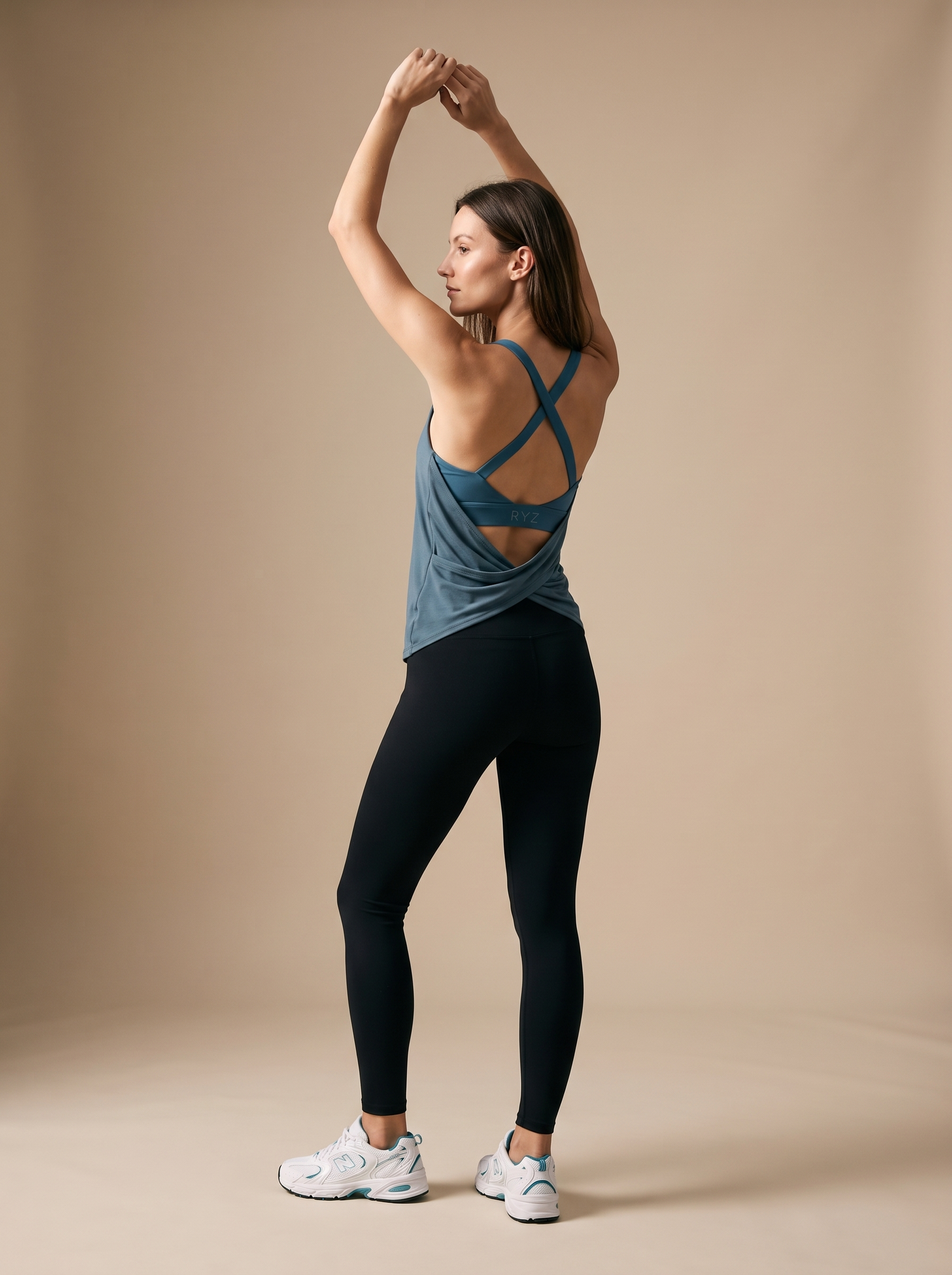
A built-in sports bra with straps that wrap or cross over a fully open back, so there is no second layer to manage and nothing solid restricting the shoulder blades. The Original Swoosh Padded Cross-Back Wrap Tank carries removable pads and a secure underband, so the support is doing the work -- not the fabric covering your back.
The Statement Open-Back: Design as Intention
A shaped, deliberate cut-out through the back panel -- a knot-blot detail, a geometric gap -- built to be looked at, not apologised for. This is the piece for the studio mirror and the post-class photo, where the back view is not incidental to how the top looks, it is the point.
The Mesh Open-Back: Coverage, With Airflow
For anyone who wants the ventilation without a bare-skin back, the Original Swoosh Full-Sleeve Sports Top keeps the back panel intact but swaps in a breathable mesh with a soft standing collar and fixed-cup padding underneath -- full coverage, full ventilation, full support, no trade-off required.

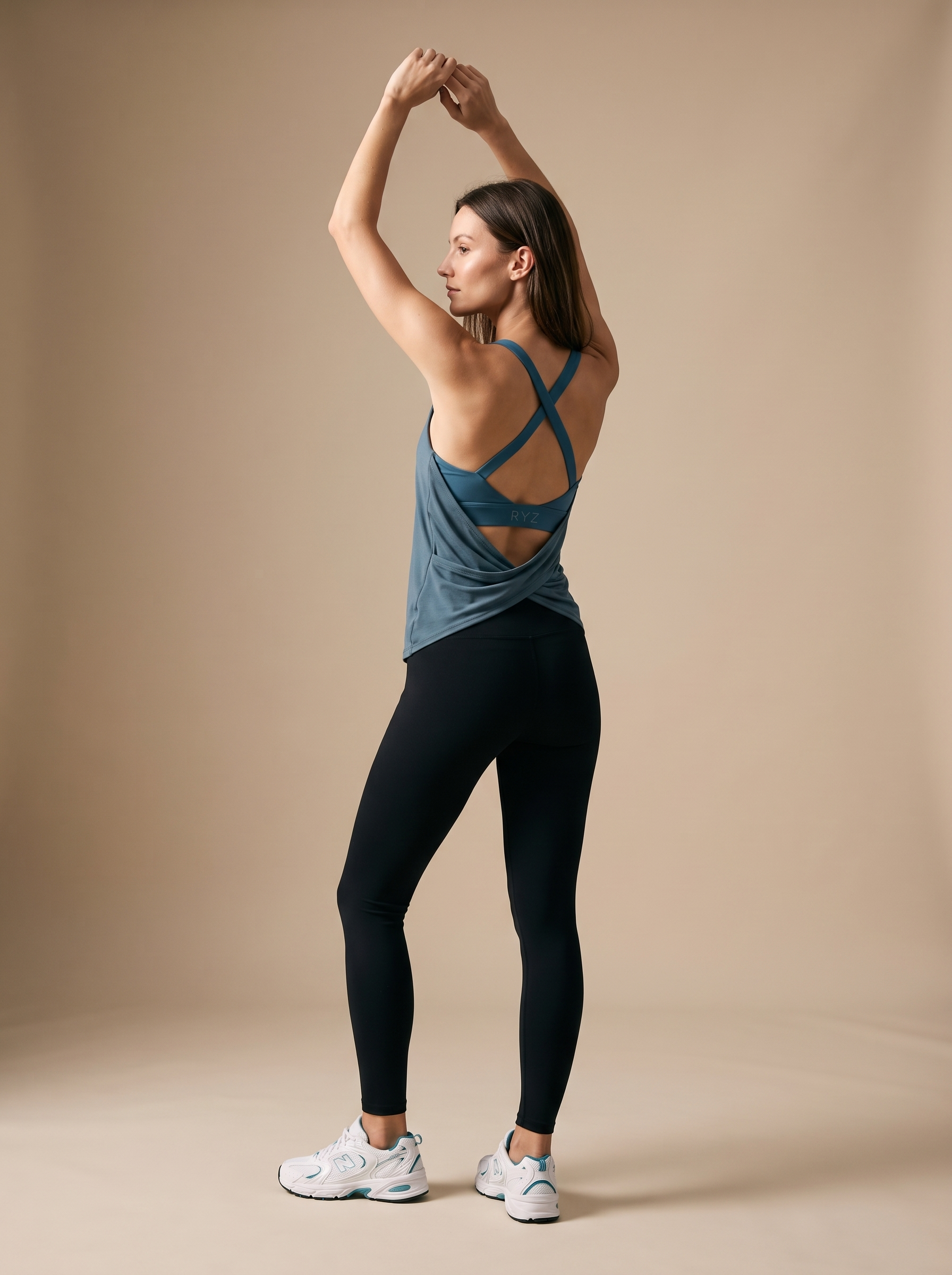
The Padded Cross-Back Wrap Tank — built-in support up front, an open cross-back designed for the shoulder's full range of motion.
05 — The Fit
Choosing Your Back, By What You're Doing
None of the three constructions is "better." Each is built for a different session, and most women in the RYZ community own more than one for exactly that reason.
| Session | Best Back Construction | Why |
|---|---|---|
| Yoga & studio floor work | Cross-back, built-in bra | Unrestricted shoulder rotation for downward dogs and backbends |
| Strength training | Mesh open-back | Full coverage and support through pulls and presses, with airflow where sweat pools |
| Studio class you're photographing after | Statement open-back | The back view is designed to be seen, not just tolerated |
| Layering under a jacket | Light cross-back bralette | Minimal bulk under a layer, still fully supported on its own |
06 — The Confidence
The Back View Is Not a Modesty Question. It's a Design One.
There is a version of this conversation that turns into a debate about how much back is "appropriate" to show. RYZ is not interested in that debate, because it is the wrong question. The right one is: does this construction do its job, and does the woman wearing it feel like she chose it on purpose?
That is why the system spans a full spectrum -- from a fully open cross-back to a fully covered mesh panel -- rather than treating "open back" as one fixed look everyone either wears or avoids. A woman who wants full coverage and full ventilation has a piece built for exactly that. A woman who wants the statement cut-out has one too. Neither is more or less confident than the other; they are simply different engineering answers to the same question.
What every piece in the system shares is the same standard: the back was decided on, not defaulted to. That is the actual definition of confident design -- not how much skin is showing, but how deliberately every inch of the garment, front and back, was built.
Explore the full range in the Sexy Back collection, or start from the Padded edit for built-in-bra pieces that do the support work themselves.
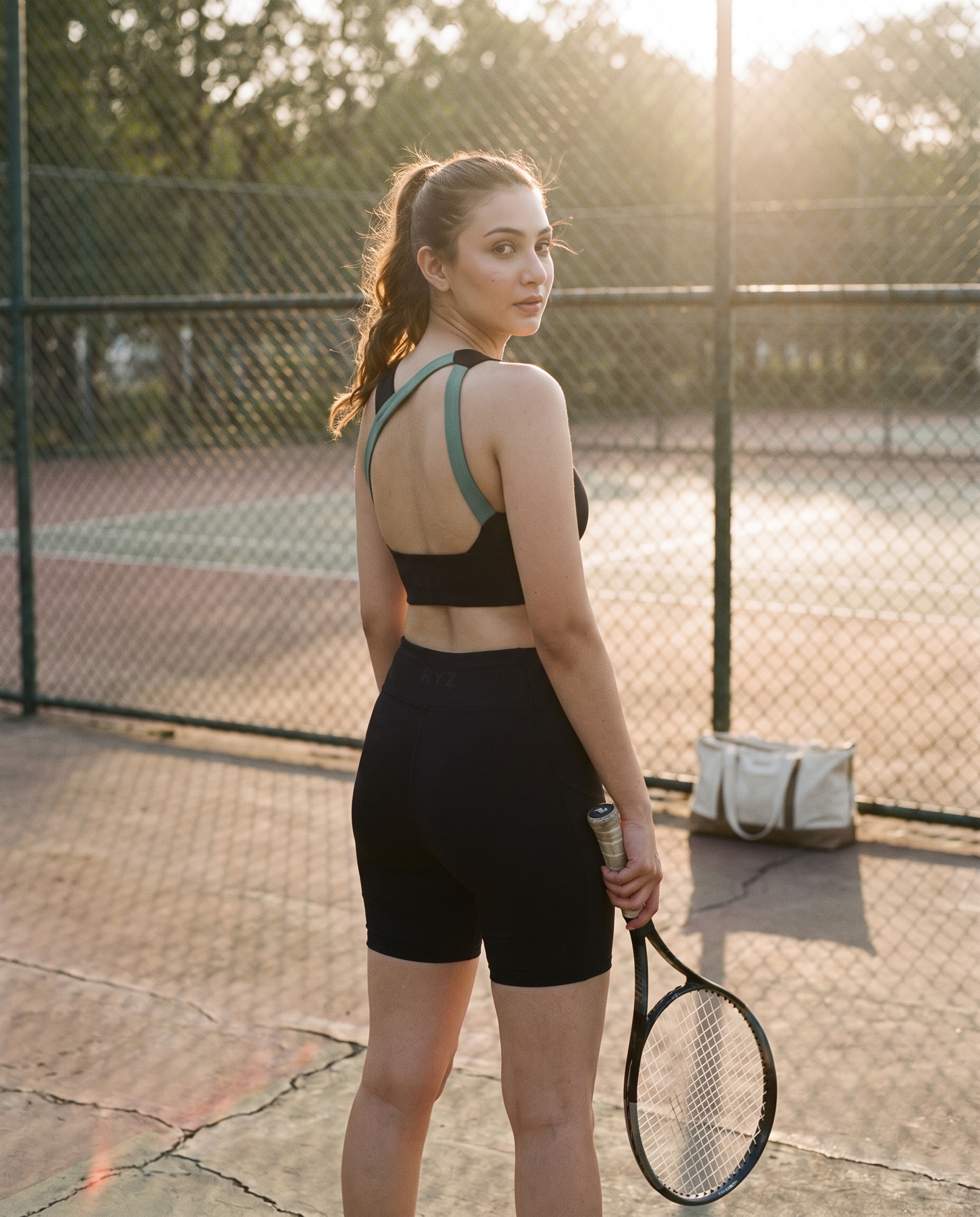
Designed to be seen from every direction.
The RYZ back system, in Softretch® — engineered for movement and finished with the same intention as the front.
Frequently Asked
Why do RYZ workout tops have an open back design?
The open back is engineered, not incidental. During any overhead or reaching movement -- a row, a downward dog, a rack pull -- the shoulder blades need to move freely, and a high, closed back panel restricts exactly that motion. An open or mesh back removes the restriction, releases heat from one of the body's warmest zones, and finishes the garment with the same intention on the back as the front, instead of treating it as the side nobody designs for.
Is an open-back top as supportive as a regular sports bra top?
Yes, when the construction is built for it. RYZ's open-back pieces carry built-in padding, a wider structured underband, and cross-back or knot-blot strapping that distributes weight across the shoulders rather than relying on a solid back panel for support. The support comes from the band and the strap geometry, not from how much fabric covers the spine.
Are open-back or backless workout tops appropriate for the gym in India?
That is entirely a matter of personal comfort, and there is no single right answer. RYZ builds the open-back family across a spectrum -- from a fully bare cross-back to a mesh-panelled back that gives ventilation with more coverage -- specifically so every woman can choose the level of back exposure she feels confident in, without giving up the ventilation and range of motion the construction is designed for.
What is the difference between a cross-back, an open-back, and a mesh-back design?
A cross-back uses straps that cross or wrap over an open back panel, distributing support across the shoulders while keeping the spine bare -- common on built-in-bra tanks. An open-back or knot-blot design cuts a deliberate, shaped gap into the back panel as a visible design statement. A mesh-back keeps the panel intact but swaps solid fabric for a breathable mesh, prioritising airflow and coverage over a bare-skin look. RYZ uses all three, depending on the piece and the activity it is built for.
Continue Reading
The front gets you noticed walking in. The back is what people remember on your way out — design it like it matters, because it does.


एक टिप्पणी छोड़ें
यह साइट hCaptcha से सुरक्षित है और hCaptcha से जुड़ी गोपनीयता नीति और सेवा की शर्तें लागू होती हैं.