
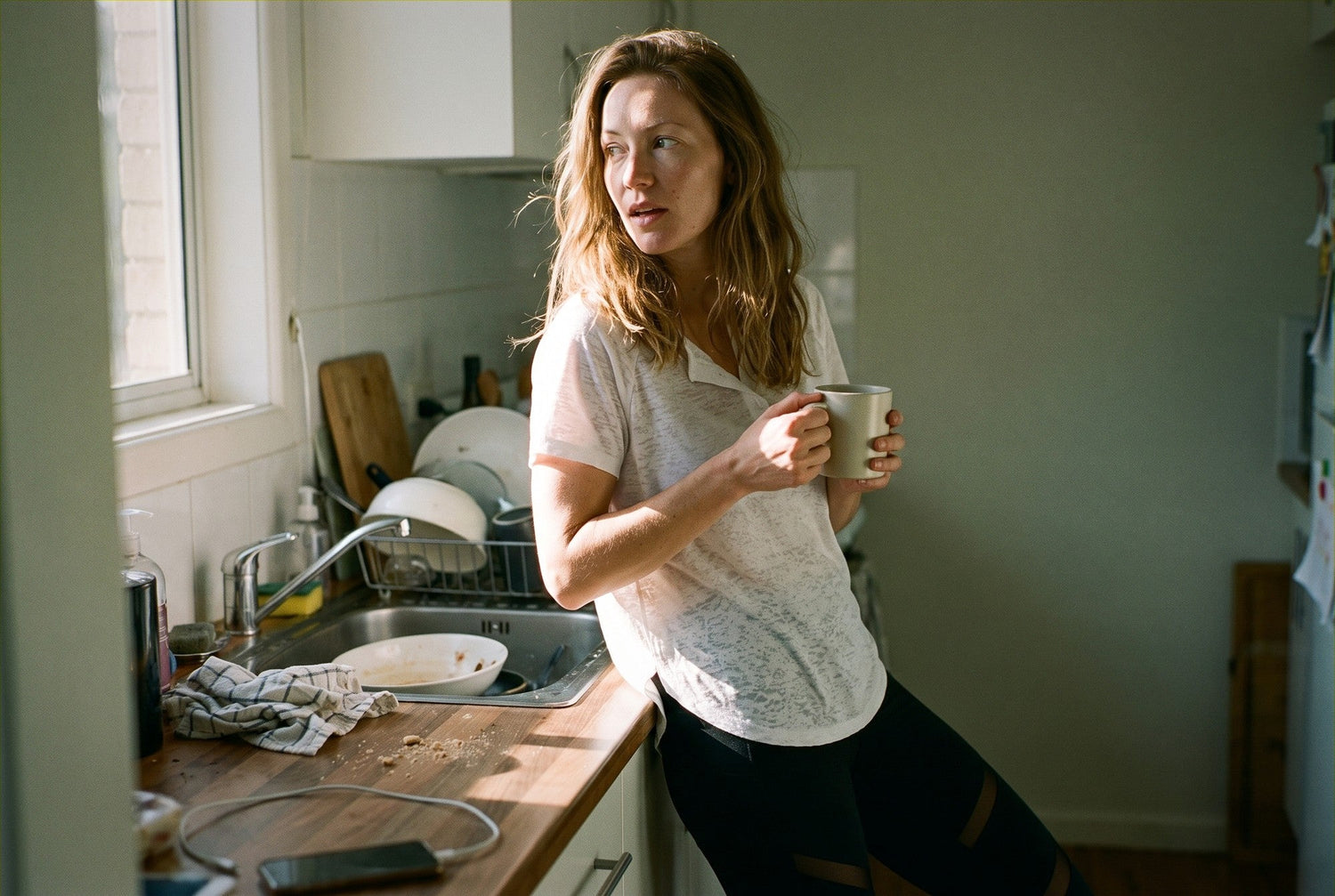

The Rest Day: What to Wear When You Are Not Training
Count the hours. Four, maybe five, in a good week — that is how long you are actually in a session. The remaining hundred and sixty-odd are spent walking, sitting, cooking, commuting, stretching on a mat at eleven at night, and doing nothing at all on a Sunday. The entire activewear industry writes about the four. This is about the rest.
01 — The Blind Spot
Nobody Dresses the Other Five Days
Open any activewear brand’s content and you will find the same room. A gym, a studio, a mat, a track. Everything is written for the moment of effort — what holds you through a squat, what wicks through a spin class, what survives a HYROX heat. It is a perfectly good body of work and it describes a small fraction of a real week.
What almost nobody writes about is the day after. The Tuesday when the legs are heavy and the plan says walk. The Sunday that involves a chemist, a long lunch, and eleven hours of doing very little in a house that is either too cold from the air conditioning or too warm without it. The evening spent on the floor with a foam roller while something plays in the background.
Most women dress those hours by accident. The piece you reach for on a rest day is usually not a piece you chose — it is a training garment that has been quietly demoted. The leggings that lost their opacity. The tee that stretched at the neck. The wardrobe of recovery is built entirely out of retired kit, which is a strange thing to accept when it is the wardrobe you spend the most time inside.
You do not get stronger during the session. You get stronger in the hours you are not thinking about it. The clothes should follow the same logic.
02 — The Principle
Rest Is Not the Absence of Training
The adaptation you are training for does not happen in the gym. A session is the stimulus; the change is written afterwards, in the hours of repair, sleep and low-grade movement that follow it. Anyone who has trained seriously through a period of bad sleep knows this in their body long before they read it anywhere.
Which reframes the rest day from a gap in the week to a part of the week with its own requirements. And once you accept that, the clothing question becomes precise rather than vague. Training garments are engineered around load: compression to manage tissue movement, support structure to carry weight, opacity that holds under stretch, fabric that moves sweat at volume. Every one of those properties is answering a question the rest day does not ask.
A rest day asks four different things. Can I sit in this for six hours without a pressure line at the waist. Does it hold a temperature across a cold office, a hot street and an evening on a balcony. Will the seams still be invisible when I am on the floor rather than upright. And can I open the door in it without feeling that I have been caught out.
The Distinction Worth Keeping
A training garment is judged by how it performs under load for ninety minutes. A rest day garment is judged by whether you can forget it for twelve hours. These are not the same specification, and a piece that is excellent at one is frequently mediocre at the other.
03 — The Situations
Five Rest Days, and What Each One Needs
“Rest day” is not one thing. It covers at least five distinct situations, and they have genuinely different requirements. Dressing all five the same way is why the category feels unsolved.
The walk that is not a workout
Six thousand steps around a lake or a colony at seven in the morning, at a pace that would embarrass you in a running club. This is the most common form of active recovery in Indian cities and the most under-served, because it sits between two wardrobes. Running kit is overbuilt for it. Home clothes are underbuilt for the humidity. What it wants is a breathable full-sleeve or relaxed top and a mid-weight legging — enough coverage for the sun, enough airflow for the eighty percent humidity, and nothing that requires a second thought at a chai stop on the way back.
Mobility and floor work at home
Ninety-ninety hip switches, thoracic openers, couch stretch, twenty minutes with a roller. You are on the ground, in deep ranges, holding positions for a minute at a time rather than moving through them. This is the situation where seam placement stops being a detail. A raised inner-thigh seam that is unnoticeable while you are walking becomes a distinct line of pressure when you are in a pigeon pose against a hard floor. Flat seams and a no-front-seam construction earn their keep here more than they do in the gym.
Physio, massage, and the sports clinic
A situation almost nobody plans for and everybody finds themselves in. You will be asked to roll a hem up, expose a shoulder, lie face down for forty minutes, and then walk out into traffic. What you want is a garment that can be moved without being removed, and a top with a clean cross-back or open-back cut that a physiotherapist can work around. What you do not want is anything you had to be sewn into. This is the one rest day where getting dressed is done in a shared room, and the finish of the garment matters more than it does anywhere else.
The errand loop
Chemist, groceries, the school run, a coffee that turns into an hour. Four stops, three temperature environments, one unplanned encounter with somebody you know. This is where the difference between activewear and off-duty dressing is decided, and it is decided by drape and finish rather than by performance. A relaxed tee that holds its shape at the shoulder and a bottom with a clean line will pass this test. A pilled training legging in its fourteenth month will not, and you will feel it at the second stop.
The long horizontal Sunday
Twelve hours, mostly seated, mostly indoors, punctuated by two meals and a nap that was not scheduled. The only real requirement is that the waistband must be irrelevant. Anything that grips, folds, or leaves a mark is disqualified, however good it is in a session. This is the day that exposes compression worn out of context faster than any other, and it is the reason a lighter classic legging deserves a place in the wardrobe alongside the sculpting one.

The floor, the light, and no particular plan. Most of the week looks more like this than like a session.
04 — The Specification
Two Different Sets of Requirements
It is worth setting the two wardrobes side by side, because the properties do not simply differ in degree. Several of them invert.
| Property | Training day | Rest day |
|---|---|---|
| Compression | Useful. Manages tissue movement under load. | Unnecessary, and counterproductive past a few hours. |
| Waistband | Structured and high, to hold through range. | Wide and even, to disappear while seated. |
| Opacity under stretch | Non-negotiable. | Still matters, but the load is far lower. |
| Sweat management | High volume, fast. | Low volume, sustained. Thermoregulation matters more. |
| Cut | Fitted, so nothing travels. | Relaxed on top, easy below. Contrast does the work. |
| Seams | Flat, to survive repetition. | Flat, to survive stillness against a hard floor. |
| The test | Does it hold for ninety minutes under load? | Can you forget it for twelve hours? |
Only one row is identical, and it is the one about seams — which is a small piece of evidence for something we have argued elsewhere, that construction quality is the property that travels across every use case. Everything else on that table is a trade-off, and a wardrobe built entirely from the left-hand column will be wrong for most of your week.
05 — The Wardrobe
Four Pieces, Chosen Deliberately
This does not need to be a large wardrobe. Rest day clothing is worn in low-sweat conditions and returns to rotation quickly, which means three or four considered pieces will cover almost everything. The point is that they are chosen for the job rather than inherited from the training drawer.
A relaxed top with real drape. The single most useful piece, because it does the visual work that makes the rest read as intentional. The Original Breeze Relaxed Tee is built for exactly this — a Softretch® relaxed cut with an open notch collar that holds its line at the shoulder instead of collapsing, which is the difference between off-duty and undone.
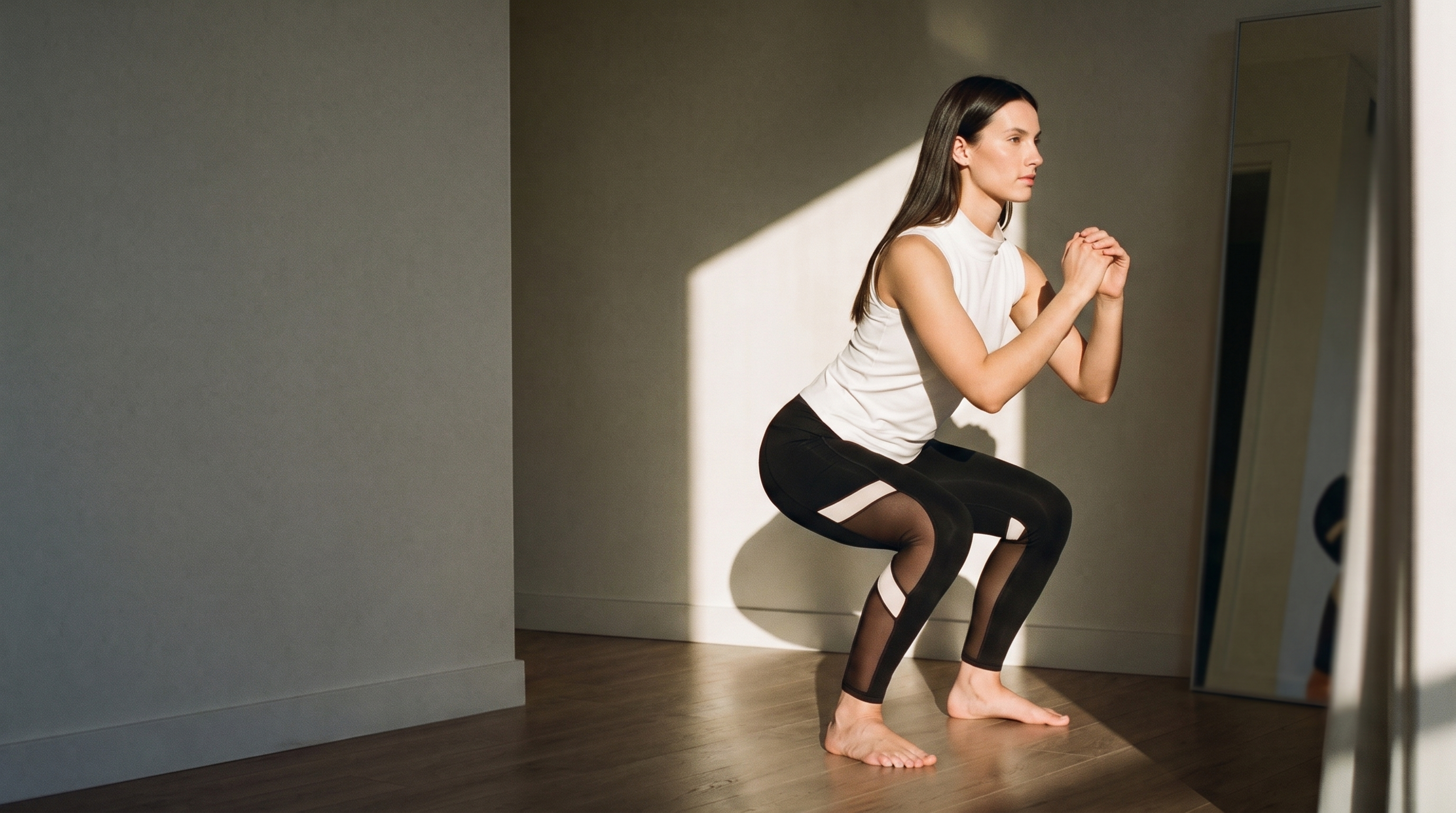
A legging you can sit in. Not a downgrade — a different tool. The Core Mesh-Slit Leggings pair a wide, even waistband with mesh set into the leg for airflow, which is what a full day of sitting actually asks for. Keep the aggressive sculpting pair for the session.
A breathable full-sleeve for the walk. Sun coverage without heat trap. The Original All-Seasons Breathable Top does this in Indian conditions specifically, which is a narrower engineering problem than it sounds and the reason most imported long-sleeves fail here by nine in the morning.
One layer that can leave the house. An elbow-sleeve jacket or an easy overshirt, kept by the door. Its entire job is to convert a rest day outfit into something you can wear to a clinic appointment or a coffee without changing. This is the piece most women do not own and use most once they do.
A Note on Colour
Rest day pieces are the ones seen most often by the people closest to you and least often by anyone else. That is an argument for the quieter end of the palette rather than the loudest thing in the drawer — not because bright is wrong, but because a garment worn four days a week wears its colour differently from one worn four hours a month.

A waistband you can sit in for six hours, and a hem that falls where it should. The whole specification, more or less.
06 — The Real Test
The Garment You Reach For When Nobody Is Watching
Here is the uncomfortable thing about rest day clothing. It is the honest audit of a wardrobe, because there is no occasion to dress up to and no session to justify the purchase. Nobody buys a rest day outfit to impress a spin class. What you reach for on a Sunday is simply what you actually like wearing, stripped of every other motive.
Which makes it the most exacting test a garment can face. A piece can look extraordinary in a photograph, perform well for ninety minutes, and still never become the thing you pull out of the drawer on a slow morning. The pieces that do become that are almost always the ones where the construction was right rather than the ones where the design was loudest — the flat seam, the band that does not mark, the fabric that has come back to its own dimension after sixty washes.
This is, in the end, the whole argument for building clothes properly. Not that a well-made garment performs better in the session, though it does. It is that a well-made garment survives into the parts of your life where performance is not the point, and quietly becomes the thing you wear most. A piece that is only good when you are training is not premium. It is equipment, and equipment lives in a bag.
So it is worth being deliberate about it. Not another set. Three or four pieces, chosen for the hundred and sixty hours rather than the four, in a palette you will not tire of, built well enough that they are still the ones you reach for in a year. The rest day is not the part of the week that matters least. It is simply the part nobody has been dressing.
For the Other Hundred and Sixty Hours
A piece that is only good when you are performing is not premium. It is equipment.
Frequently Asked Questions
What should I wear on a rest day?
Rest day clothing should do the opposite of training clothing. Look for a relaxed or semi-relaxed cut rather than compression, a waistband that sits without gripping because you will be seated for hours rather than moving through range, a fabric that breathes in both air conditioning and outdoor heat, and a finish that still looks composed if you end up outside the house. In practice that is usually a soft relaxed tee or a breathable long-sleeve top with a mid-rise legging or an easy pant. The test is simple: at the end of eight hours you should not be able to remember what you put on.
Is it bad to wear leggings all day?
Wearing leggings all day is not inherently a problem, but wearing high-compression training leggings all day can be. Compressive garments are engineered to apply sustained pressure across the thigh and torso, which is useful for a ninety-minute session and unnecessary for twelve hours of sitting, driving and standing in a kitchen. The issues that come up are pressure lines at the waist, restricted comfort after meals, and heat retention. For an all-day rest day, choose a lighter classic legging with a wide, unstructured-feeling waistband over a sculpting or compressive one, and give the fabric room to breathe.
What is active recovery and what should I wear for it?
Active recovery is deliberately low-intensity movement on a non-training day, intended to increase blood flow without adding training load. In practice it means a long easy walk, gentle mobility work, light stretching, swimming, or an unhurried cycle. Because the intensity is low, the clothing does not need support structure or high compression. It needs thermoregulation, unrestricted range at the hip and shoulder, and seams that will not become pressure points when you are on the floor. A breathable full-sleeve top and a mid-weight legging is a more useful combination here than anything built for the gym.
Should rest day clothes be loose or fitted?
The most useful answer is one of each. A relaxed top over a fitted bottom is the combination that reads as composed rather than unmade, and it is why the relaxed tee with a classic legging has become the default off-duty uniform rather than the full tracksuit. Fully loose on both halves tends to look like sleepwear in daylight; fully fitted on both halves keeps you in training-clothes mode on a day when the point is not to be. The contrast is doing the work, not the individual pieces.
How many rest day pieces do I actually need?
Three or four, if they are chosen properly. Two relaxed tops, one easy bottom and one layer will cover almost every non-training situation, because rest day clothing is worn in low-sweat conditions and comes back into rotation faster than training kit. The mistake is not owning too few, it is owning none deliberately and defaulting to whatever is clean, which is usually a worn-out training piece that has been demoted rather than a garment chosen for the job.
Continue Reading
The week is not four hours of effort surrounded by dead time. It is one continuous thing, and the clothes that only work for the loudest part of it are not really working. Dress the quiet hours as deliberately as you dress the session, and you will find you were never choosing between comfort and composure at all.


एक टिप्पणी छोड़ें
यह साइट hCaptcha से सुरक्षित है और hCaptcha से जुड़ी गोपनीयता नीति और सेवा की शर्तें लागू होती हैं.