

The Lifting Edit: What to Wear When You Train With Weights
Something has changed on the gym floor. The rack is no longer the far corner of the room that women walk past on the way to the treadmills. It is where they are heading. And the wardrobe most women bring to it was designed for a different kind of training entirely.
01 — The Shift
The weights floor stopped being a men’s room
For most of the last decade, Indian women’s fitness was sold as a cardio proposition. Burn something. Sweat through something. Come back smaller. The clothes followed that logic faithfully: light, forgiving, built for movement that happened mostly in one plane and mostly at speed.
That premise has quietly collapsed. Across metro gyms, women are signing up for strength-based training in numbers that would have seemed implausible three years ago, and they are not there to tone. They are there to get under a bar and add weight to it week after week. The vocabulary has changed with the behaviour — progressive overload, bracing, hip hinge, working sets — and it is now ordinary to hear it in a Bandra gym at seven in the morning.
What has not changed is the wardrobe. Most women are still lifting in clothes designed for a studio class: soft, light, low-structure pieces that behave beautifully on a mat and betray you the moment there is load involved. The garment was never the point of failure before. Under a barbell, it becomes one.
02 — The Engineering Problem
What load actually does to a garment
Lifting is not simply a harder version of a studio class. It is a mechanically different activity, and it stresses fabric in three specific ways that yoga and Pilates never do.
The first is compression at the fold. A deep hip hinge — the shape you make in a deadlift, a good morning, a heavy Romanian — concentrates enormous pressure at the waistband. A narrow band has no surface across which to distribute that force, so it does the only thing it can: it folds, and then it rolls. This is not a sizing failure, though it is almost always diagnosed as one. It is a construction failure.
The second is drag. A loaded bar makes contact with the body in ways nothing else does. It runs down the shin in a deadlift, sits across the hips in a thrust, rests on the upper back in a squat. Knurling is designed to grip, and it does not distinguish between a hand and a thigh. Thin, low-density fabric abrades against it. Full-length leggings are not a modesty choice on the weights floor; they are a contact surface.
The third is overhead travel. Press anything above your head and a cropped or loosely structured top will migrate upward and stay there. In a studio class that is a mild irritation. Mid-set, with a loaded bar overhead, it is a distraction at precisely the moment you cannot afford one. Every adjustment you make between reps is attention taken away from the lift.
A garment you have to think about is a garment that is costing you a set.
03 — Support
Why the highest support is not the right support
The instinct, when training gets heavier, is to reach for the most restrictive bra available. It is the wrong instinct, and it comes from applying running logic to a non-running problem.
High-impact support exists to solve vertical displacement — the repeated bounce of running, skipping, jumping. It solves that by clamping the ribcage. But lifting is a low-bounce activity with a high demand for something else entirely: breath. Bracing under load requires you to draw a full breath, expand the ribcage laterally, and hold it. A bra engineered to prevent chest movement is, by design, working against the mechanic that keeps you safe under weight.
What the weights floor actually asks for is medium-to-high support with a secure, well-constructed band and straps that will not shift when your shoulders move through a full range. The band does the holding; the compression does not need to. Removable padding matters more here than most women expect, because it lets you set the structure you want rather than accept whatever the garment decided for you.
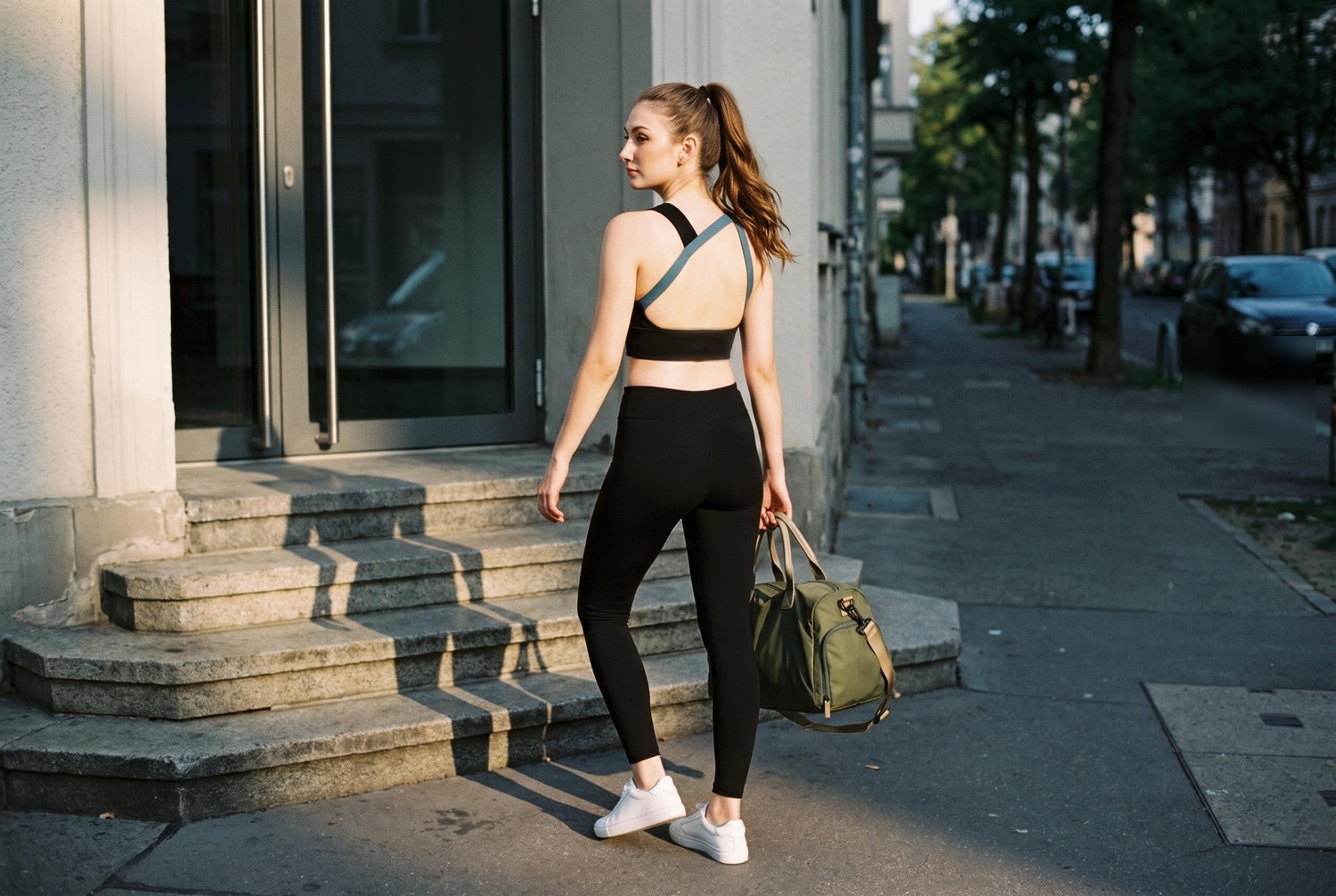
A cross-back or racer construction earns its place for a practical reason rather than an aesthetic one: it keeps the straps clear of the shoulder line, which is where a bar sits in a back squat and where straps have a habit of migrating during overhead work. RYZ builds this into the padded range as standard — in-built support with removable pads, so the top is the whole garment rather than a layer over another one.
The Layering Test
If you are wearing a sports bra under a separate top, you are managing two garments through every set — two hems, two straps, two things that can shift. A single engineered piece with built-in support removes an entire category of mid-set adjustment. It is a small change that you notice most on the days you are training heaviest.
04 — Building It
The lifting kit, in four decisions
Start with the waistband, not the legging
Everything else about a bottom is secondary to whether the waistband survives a hinge. You want high-rise, genuinely wide, and constructed with recovery — fabric that returns to shape rather than stretching out over a session. Test it in the changing room by folding forward into a full hinge. If it folds, it will roll under load.
Choose length by contact, not by weather
If your programme has deadlifts, hip thrusts or anything where a bar travels along the body, go full length. The fabric is doing protective work. If you are squatting, lunging and pressing in a warm gym, a well-constructed biker short with a proper waistband gives you the knee travel without the heat.
Let the top be the whole garment
A built-in bra top with removable pads and a cross-back construction does the work of two pieces without the failure points of either. If you prefer a layer, make it a fitted one with a hem that stays — a relaxed drape reads well on a mat and rides straight up during overhead press.
Add a layer you can train in, not just arrive in
Warm-up sets happen cold, and Indian gyms are aggressively air-conditioned. A sleeveless or elbow-sleeve jacket that you can keep on through the first working set, then shed, is more useful than an oversized hoodie you take off at the door and never touch again.

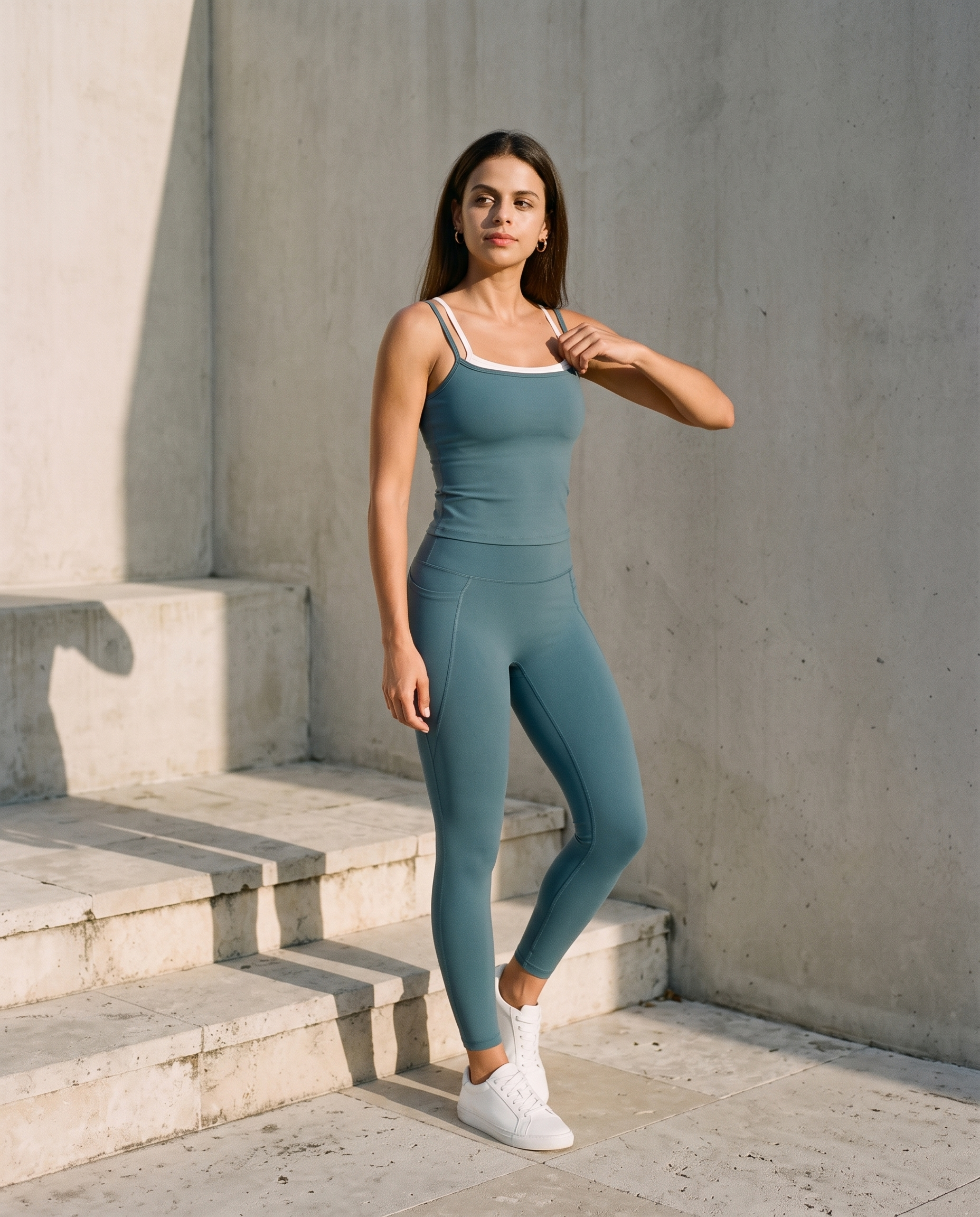
High-rise construction in Softretch® — built to hold position through a full hinge.
05 — The Difference
Studio kit and lifting kit are not the same kit
| Studio and mat | The weights floor | |
|---|---|---|
| Main stress | Stretch and range | Compression, drag and load |
| Waistband | Comfort priority | Structural priority |
| Support level | Light to medium | Medium to high, band-led |
| Fit of top | Relaxed reads well | Fitted, hem must hold |
| Failure mode | Sheerness in a fold | Roll-down and ride-up |
| What you notice | How it feels | Whether you notice it at all |
06 — The Longer Point
Dressing like you intend to stay
There is a quieter thing happening underneath the equipment and the technique, and it is worth naming. A woman who walks onto the weights floor in clothes that were chosen for it is making a statement to herself before she makes one to anybody else. She is not visiting. She is not going to reassess this in a month. She belongs to the room.
That is the part that clothing can genuinely do. It cannot add weight to your bar. But it can remove every small friction that pulls attention away from the set in front of you — the hem you keep tugging, the band you keep resetting, the strap you keep moving. Strength training is a long practice, measured in years rather than weeks. The wardrobe should be built the same way.
Frequently Asked Questions
What should women wear for weight training in the gym?
A medium-to-high support bra top, a high-rise legging with a wide waistband that will not fold under a hip hinge, and a top that stays put when your arms go overhead. Lifting is a low-bounce, high-load activity, so the priority is not impact protection but stability: nothing that shifts, rolls or needs adjusting between sets.
Are leggings or shorts better for lifting?
Both work, and the choice is about contact rather than coverage. Full-length leggings give you grip and protection against a knurled bar during deadlifts and hip thrusts. Biker shorts give you unrestricted knee travel for squats and lunges in warm weather. What matters more than length is the waistband: it needs to sit high and stay flat through a full hinge.
Do I need a high-impact sports bra for lifting weights?
Not usually. High-impact support is engineered for running and jumping, where vertical displacement is the problem, and it often restricts the ribcage expansion you need for bracing under load. Medium-to-high support with a secure band is the better fit for most strength sessions, unless your programme includes conditioning intervals or plyometrics.
Why do my leggings roll down when I squat or deadlift?
Roll-down is a waistband engineering problem, not a size problem. A narrow or thinly constructed waistband has nothing to distribute pressure across, so a deep hip hinge folds it. A high-rise waistband with real width and recovery in the fabric holds its position because the load is spread rather than concentrated at a single fold point.
Built for the Rack
Engineered to hold position, so you can hold the bar.
Continue Reading
The bar does not care what you are wearing. You should not have to either — and that is the whole point of dressing well for it.



एक टिप्पणी छोड़ें
यह साइट hCaptcha से सुरक्षित है और hCaptcha से जुड़ी गोपनीयता नीति और सेवा की शर्तें लागू होती हैं.