

The Cost-Per-Wear Case: Why Buying Less Actually Works
Nobody budgets for activewear the way they budget for anything else that matters. A Rs 799 legging feels like a bargain at the till and a false economy eight weeks later, once it has pilled, sagged, or gone into the drawer you don't open. The real cost of a garment was never on the price tag. It was always in how many times you actually wear it.
01 — The Math Nobody Runs
Price is not the same thing as cost
Cost-per-wear is a simple calculation that almost nobody runs before buying activewear, even though most women run it instinctively for a handbag or a coat. Take the price, divide it by the number of times you genuinely wear the piece before it is retired, and you have the real number. It is rarely the number on the receipt.
A legging bought for Rs 799 that loses its shape after fifteen wears costs more than Rs 53 every time you put it on. A legging bought for Rs 1,999 that holds its shape for two hundred wears costs exactly Rs 10. The second purchase looked more expensive at the till and was, in fact, the cheaper decision by a factor of five.
This is not an argument for spending more. It is an argument for measuring correctly. 2026 has quietly become the year Indian fashion consumers started saying this out loud — the shift toward fewer, better-made pieces over fast-fashion volume is now a named trend, not a niche preference. The maths was always there. The habit of running it is new.
02 — The Failure Point
Why cheap activewear fails on a schedule
A garment does not fail randomly. It fails at the exact points where cost was cut to hit a lower price, and those points are almost never visible on the hanger.
Fabric recovery is the first to go. Good stretch fabric returns to its original shape after every wear and wash. Cheaper fabric stretches once, sags a little, and never fully recovers — which is why a legging can look fine in the shop and feel loose within a month of real wear.
Seam construction is the second. A flat-lock seam distributes stress across the stitch line. A single straight seam concentrates it at one point, which is exactly where you will find the first hole, usually at the inner thigh or the underarm, usually sooner than you expected.
Waistband structure is the third. A thin elastic band feels identical to a properly constructed one on day one. By week three, one has held its shape and the other has started to roll. None of this is visible when you are deciding what to buy. It is only visible in how the piece behaves under repeated, ordinary use — which is the entire point of a cost-per-wear argument.
A cheap price and a cheap garment are two different claims. Only one of them is printed on the tag.
03 — The Other Lever
Wears matter as much as durability
Durability is only half of the cost-per-wear equation. The other half is how many different contexts a single piece can actually earn its place in. A garment built for one activity and one activity only has a hard ceiling on how many times it gets worn, no matter how well it is made.
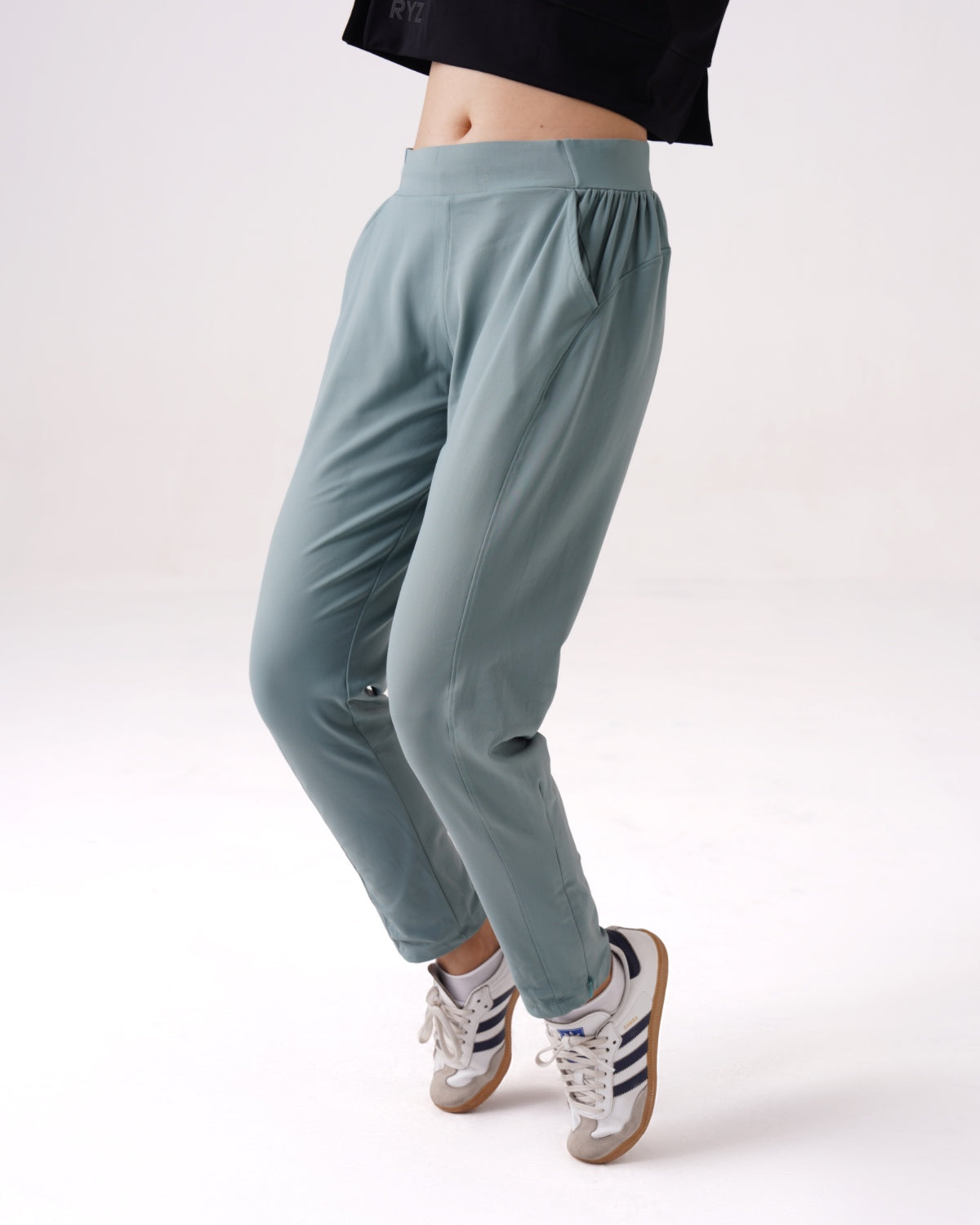
This is why versatility is not a styling nice-to-have; it is a direct input into the maths. A pant built to move from a training session to a work call to a flight without changing has a wear count that a single-purpose gym legging can never reach, simply because it gets picked up on more days for more reasons. Two garments with identical construction and identical durability can land on completely different cost-per-wear numbers, purely because one of them fits into more of your week.
The Ten-Wear Test
Before buying, ask honestly: can you picture ten separate occasions you would reach for this exact piece in the next two months? Not ten hypothetical scenarios — ten real ones, tied to things already on your calendar. If the honest answer is two or three, the price on the tag is not the real price you are paying.
04 — Buying Well
Four questions to ask before you buy
Does the fabric recover, or just stretch?
Pull the fabric taut and release it. It should return to its original shape immediately, with no visible slack or ripple. If it takes a moment to settle, it will take even longer after twenty washes.
Are the seams flat-locked?
Turn the garment inside out. A flat-lock seam lies smooth and distributes stress along its length. A single visible stitch line at a high-movement point — inner thigh, underarm — is the first place a cheaper garment will give way.
Does the waistband feel structured?
Press it between your fingers. A well-built band has body and returns to its line when released. A thin elastic band gives way immediately and will roll under real movement within weeks.
Where else would you wear this?
If the honest answer is nowhere but the gym, the wear count has a low ceiling before you even get to durability. The best cost-per-wear pieces earn their place in more than one part of your week.
05 — The Comparison
Two purchases, run to their real number
| Fast-turnover piece | Engineered piece | |
|---|---|---|
| Sticker price | Lower | Higher |
| Fabric recovery | Fades within weeks | Holds for years |
| Contexts worn in | One | Several |
| Typical wear count | 15–25 | 150–250+ |
| Real cost-per-wear | Higher | Lower |
| What you notice | Replacing it, repeatedly | Not thinking about it at all |
06 — The Longer Point
Buying less is not a compromise
RYZ has never run a flat-percentage sale, and this is the reasoning underneath that choice made plain. A discount changes the number on the tag. It does not change how long a garment holds its shape or how many contexts it earns a place in. Chasing the lower sticker price and ignoring the wear count is how a wardrobe fills up with things that were technically inexpensive and practically wasteful.
Buying less, and buying pieces built to be worn constantly rather than occasionally, is not deprivation dressed up as virtue. It is simply running the correct maths. Fewer pieces, each one earning its place across more of your week, for longer, is not a smaller wardrobe. It is a more accurate one.
Frequently Asked Questions
What does cost-per-wear actually mean?
Cost-per-wear is the price of a garment divided by the number of times you actually wear it before it is retired. A Rs 2,000 legging worn 200 times costs Rs 10 per wear. A Rs 800 legging worn 15 times before it loses shape costs over Rs 53 per wear. Price alone tells you almost nothing about value.
Why does cheap activewear wear out so quickly?
Most of the visible cost in a garment goes into the fabric face and the finish. Fabric recovery, seam density, and waistband construction cost more and show up less, so they are usually the first things cut. The result is a piece that looks identical off the rack but loses stretch, pills, or sags within weeks of real use.
How can I tell if an activewear piece is built to last?
Stretch the fabric and watch how it returns: good recovery snaps back immediately with no visible slack. Check the seams for flat-lock stitching rather than a single visible line. Press the waistband between your fingers; it should feel structured, not just elasticated. And ask what else you would wear it for beyond the one activity it was bought for.
Is buying fewer, more expensive activewear pieces actually cheaper?
In most cases, yes, once you measure it in cost-per-wear rather than sticker price. A well-built piece that gets worn across the gym, travel, and everyday errands accumulates hundreds of wears rather than dozens, which brings its true cost below that of several cheaper pieces bought to replace it over the same period.
Continue Reading
The tag shows a price. Only time shows the cost. Buy for the second number.


एक टिप्पणी छोड़ें
यह साइट hCaptcha से सुरक्षित है और hCaptcha से जुड़ी गोपनीयता नीति और सेवा की शर्तें लागू होती हैं.