
Home › Journal › The Pocket Problem
Engineered ComfortThe Pocket Problem
Why most activewear pockets don't work, and what it takes to build one that does.

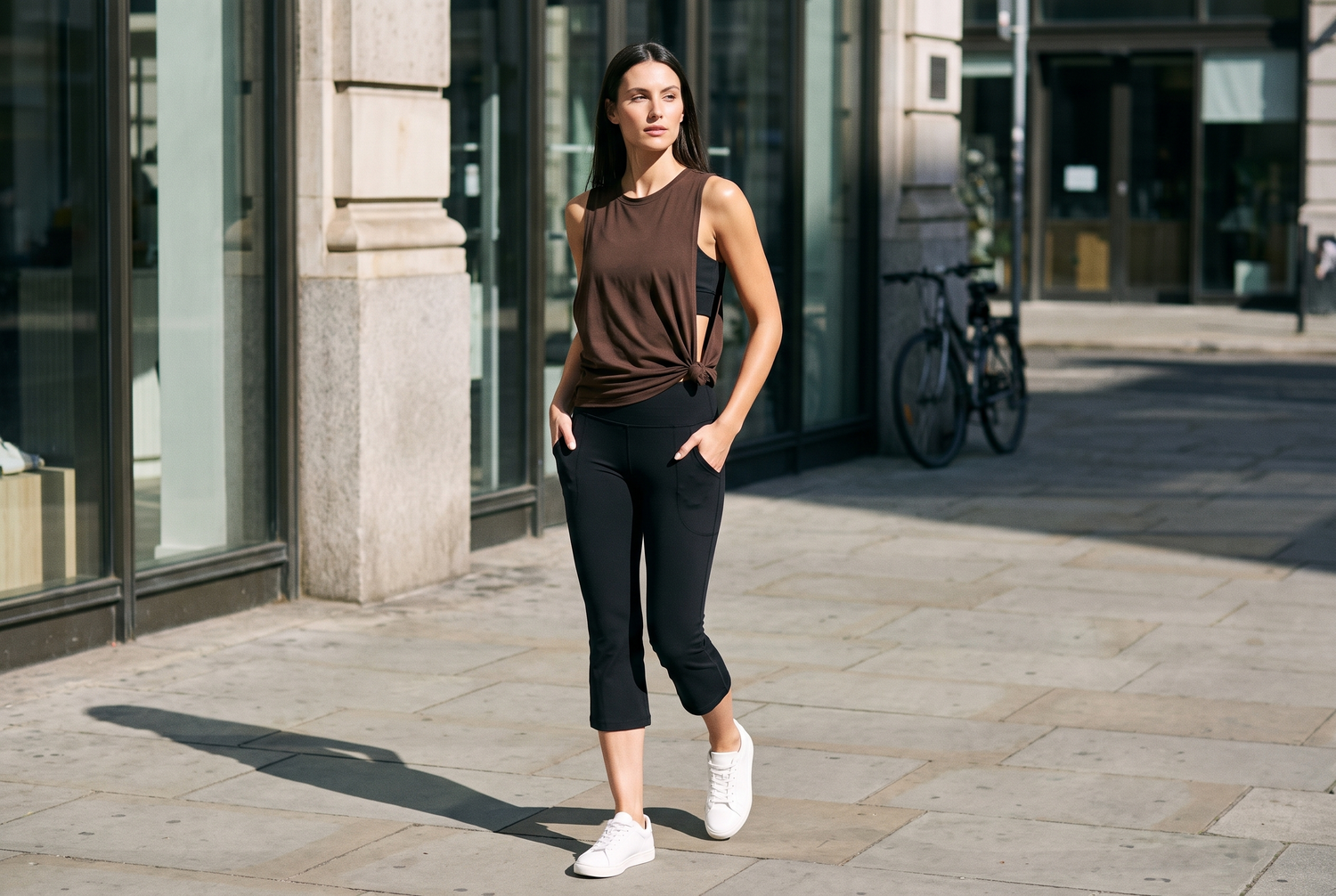
Core Active Flair Capri Leggings in Black, with the Core Layer Tank in Chocolate Brown. The opening sits high, the bag runs deep. That is the whole difference.
You bought them because the listing said pockets. Then you put your phone in one, walked to the end of the road, and felt the waistband start its slow slide down one hip. By the time you reached the gate you were holding the phone in your hand, which is where it stayed for the rest of the walk. The pocket existed. It just wasn't load-bearing.
This is the most quietly universal disappointment in women's activewear. Pockets have become a search filter, a bullet point, an entire product category on every marketplace in the country. What almost nobody has explained is why so many of them fail, and the reason is not laziness or cost-cutting alone. It is that a pocket in a compression garment is a genuinely hard engineering problem, and most of the industry solves it by pretending it isn't one.
Understand the problem and you can assess a pair of leggings in a fitting room in about fifteen seconds, without ever putting your phone in them.
One
A pocket fights the fabric that holds you
Start with what a legging is actually doing. A compression legging holds its shape by keeping the knit under continuous, even tension across the whole leg. That tension is the entire product. It is what makes the fabric sit smooth instead of wrinkling at the knee, what stops the waistband rolling, and what produces the sensation people describe as supportive.
Now hang two hundred grams off it.
A modern phone weighs somewhere between 180 and 220 grams. That is not much in a handbag. On a panel of four-way stretch knit that is already pulled taut, it is a significant point load, and elastane responds to load the only way it can: it elongates. The fabric stretches locally in the direction of the weight, the tension in that zone drops relative to everywhere else, and the garment redistributes. What you feel as the waistband sliding down one side is the knit doing exactly what it was engineered to do, in a place where nobody wanted it to.
This is why the failure is so consistent across brands and price points. It is not a manufacturing defect. It is physics arriving on schedule.
A pocket cut into a compression panel is not a feature added to the garment. It is a hole cut in the thing that was holding you up.
Two
The four ways a pocket fails
Once you know what the load is doing, the failure modes become predictable. There are four, and most disappointing pockets exhibit at least two.
Drag
The waistband descends on the loaded side. This is the elongation described above, and it is the single most common complaint. It gets worse the higher the pocket sits, because a pocket near the hip is closer to the waistband and pulls on it more directly. A pocket at mid-thigh has the length of the thigh panel to absorb the load before it reaches the waist.
Bounce
The object travels inside the pocket on every stride. This is a sizing failure, not a placement one. If the pocket is deeper or wider than what goes in it, the difference is slack, and slack is exactly what oscillates. A generous pocket feels reassuring in a shop and behaves badly at any pace above a walk. The correct pocket is sized close to its intended contents, with an opening under slightly higher tension than the body of the pocket, so the object is held rather than stored.
The outline of the object reads through the fabric. Partly aesthetic, mostly a density problem. A single-layer pocket in a light knit shows everything, and a phone-shaped rectangle on the thigh undoes the clean line the legging was built to produce. The fix is either a dedicated inner layer or enough knit density in that zone to diffuse the edge, and both cost more than a bound slit.
Press
The pocket becomes a pressure point. This one only shows up in specific movement. Lie on your side for a hip series, sit back into a low squat, get into a car, and a seam or zip that was invisible standing up becomes a hard line against the body. It is the reason exposed hardware belongs on a woven short and almost never on a high-stretch legging.
The fifteen-second test
In a fitting room, put your own phone in the pocket and do three things: stand still and look at the waistband from the front, take four brisk steps, then sit down. Drag shows in the first, bounce in the second, press in the third. Print you will already have seen. Nearly every pocket that is going to disappoint you will do it inside those fifteen seconds.
Three
Where a pocket is allowed to go
There are only three positions on a legging that can carry weight without cost, and each is suited to a different thing.
The thigh, on the outer front. This is the only correct home for a phone, and it is worth being precise about what "position" means here. The opening usually sits high, near the hip, because that is where a hand naturally enters. What matters structurally is not the opening but where the weight comes to rest: the bag should hang down so the phone settles over the upper-to-mid thigh. The thigh is the widest part of the leg, the fabric there is closest to flat rather than wrapped, and the panel has the full length of the leg below it to absorb elongation before the waistband ever feels it. It is also the position where the object stays closest to the body's centre line during a stride, which is what keeps it from swinging. A pocket with a hip-height opening and a shallow bag puts the load straight onto the waistband and drags. The same opening with a deep bag does not. Every legging that genuinely holds a phone well gets this distinction right.
Hidden, inside the waistband. The waistband is already the densest, most stable, most highly engineered part of the garment, because it has to resist roll-down. That structure can be borrowed. A small internal pocket there carries a card, a key, a locker token, without asking the waistband to do anything it wasn't already doing. It cannot take a phone, and a waistband pocket advertised as phone-capable is a promise the construction cannot keep. Our Swoosh Sculpt Performance Leggings use exactly this, paired with a side towel holder, which is the other thing your hands are full of in a gym.
On a lower-stretch panel entirely. If you want a zip, put it somewhere the garment is not under compression. This is why the pocket question resolves so much more cleanly on shorts: a woven or lower-stretch outer body can take a concealed zip, hold it flat, and never turn it into a pressure point. The Core Gym Shorts with Towel Loop carry two deep zip pockets for exactly this reason, and it is not a coincidence that the zips live there and not on a legging.

Core Gym Shorts with Towel Loop. A lower-stretch outer body is where a concealed zip belongs.
Four
Two kinds of pocket, and why the difference costs money
There is a version of the pocket that gets built in the first week of a garment's design, and a version that gets added in the last. They look similar on a product page and behave nothing alike.
| Added pocket | Engineered pocket | |
|---|---|---|
| Decided | After the panel layout is final | Before it, as part of the layout |
| Construction | Slit cut in an existing panel, edge bound | Own panel, own seam path, own knit density |
| Depth | Generous, because generous sounds better | Sized to the object, to remove slack |
| Under load | Waistband drags, phone prints and bounces | Load stays in the thigh panel, line stays clean |
| Cost to make | Almost nothing | Meaningfully more, at every stage |
That last row is the whole explanation. An added pocket satisfies the product listing, the filter, and the search query. It costs the manufacturer close to nothing and it converts. The failure only surfaces on the third or fourth wear, at which point the transaction is long finished and the garment quietly becomes the pair you wear when you are not going anywhere.
An engineered pocket has to be designed in from the start, because everything it needs, the panel, the seam path, the density in that zone, is decided before a single stitch exists. There is no way to retrofit it. That is why good pockets are rarer than they should be in a category where pockets are one of the most-searched features.
Five
What we build, and why we build it there
RYZ takes a position on this that is easy to state: a pocket either carries the thing you meant to put in it, or it should not be on the garment.
On the Core Active Flair Capri Leggings, the two side pockets open as clean tonal slashes set into the front-outer panel, then run hand-deep down the thigh rather than stopping at phone depth, which is what lets them hold a phone still instead of letting it travel. The same pair runs our no-front-seam construction, so there is no vertical seam competing with the pocket for the front line of the garment, and the kick-flare hem at mid-calf means the whole thing reads as a trouser from the knee down. That combination is the reason it leaves the studio and goes to lunch.
On the Signature Sculpt Active Set, the leggings carry deep side pockets alongside a high-waist compression band and the same no-front-seam finish, because a set has to work as hard as its parts. And on the Swoosh Sculpt Performance Leggings, the choice was deliberate in the other direction: a hidden secure waist pocket for cards and keys, plus a towel holder on the side, rather than a large thigh pocket that would have compromised the sculpt panel. Not every pair should try to carry a phone. The honest thing is to say which one does.
Softretch®, our 81% polyamide and 19% spandex knit, is what makes the thigh placement viable at all. Its stretch recovery is high enough that the panel returns to shape after being loaded, rather than gradually surrendering across a season, which is the slower and more insidious version of the same failure.
Designed in, not added on
A pocket should hold what you put in it. Everything else is decoration.
The pocket is a small thing, which is precisely why it is worth arguing about. Nobody chooses activewear on the strength of a pocket. But the brand that got the pocket right had to make a harder decision months before you ever saw the garment, and that decision is visible in everything else it built.
Questions
The Pocket Problem, answered
Why do my leggings with pockets sag when I put my phone in them?
Because the pocket was added to a panel that was already doing a structural job. Compression leggings hold you by pulling fabric taut across the leg. A phone is roughly 180 to 220 grams hanging off that taut panel, and the fabric has no choice but to yield in the direction of the load. The result is a localised stretch that pulls the waistband down on one side. A pocket only avoids this if it is built into a zone that carries no compression load, or if the surrounding panel is engineered at a higher density to absorb it.
Where should a pocket sit on workout leggings?
For a phone, on the outer front of the thigh. The opening usually sits high, near the hip, because that is where the hand enters, but what matters is where the weight rests: the bag must be deep enough that the phone settles over the upper-to-mid thigh, where the leg is widest and the fabric is closest to flat. A hip-height opening with a shallow bag drags the waistband; the same opening with a deep bag does not. For small items such as keys or a card, a hidden waistband pocket works well, because the waistband is already the densest and most stable part of the garment. Back pockets are the worst position for anything with weight, because they sit directly on the part of the waistband that has to resist roll-down.
Do leggings with side pockets bounce when you run?
They bounce if the pocket is deeper than the object inside it, which is the most common design failure. A phone in a loose pocket travels the difference between the two on every stride, and that movement is what you feel. A pocket sized close to the object, with a slightly higher-tension opening, holds it still. Depth is not generosity in a pocket. It is slack, and slack is what bounces.
Are zip pockets better than open pockets in activewear?
For anything you cannot afford to lose, yes, but only if the zip is concealed and lies flat. An exposed zip on a compression garment creates a hard line against skin and becomes a pressure point during floor work or any seated position. A concealed zip in a woven or lower-stretch panel, such as on gym shorts, is the better application. On a high-stretch legging, a well-placed deep pocket without a zip is usually the more comfortable engineering answer.
Why don't more activewear brands put good pockets in leggings?
Because a pocket that works is a construction decision made early, not a feature added late. It changes the panel layout, the knit density in that zone, and the seam path. That is more expensive than cutting a slit in an existing panel and binding the edge, which is what most pockets in the market actually are. The cheap version satisfies the product listing and fails in use, and by then the sale is already made.
Continue Reading
More from the RYZ Journal
Construction
Second Skin
Why the seams are the most important thing you never notice.
Fit
The Fit Test
How activewear is meant to fit, and how to tell when it doesn't.
Fabric
The Sweat Question
Why some activewear shows it and some doesn't.
Wardrobe
The Rule of Nine
Building an activewear wardrobe that actually gets worn.


Leave a comment
This site is protected by hCaptcha and the hCaptcha Privacy Policy and Terms of Service apply.